Why we cap the fee on every transaction
What changed
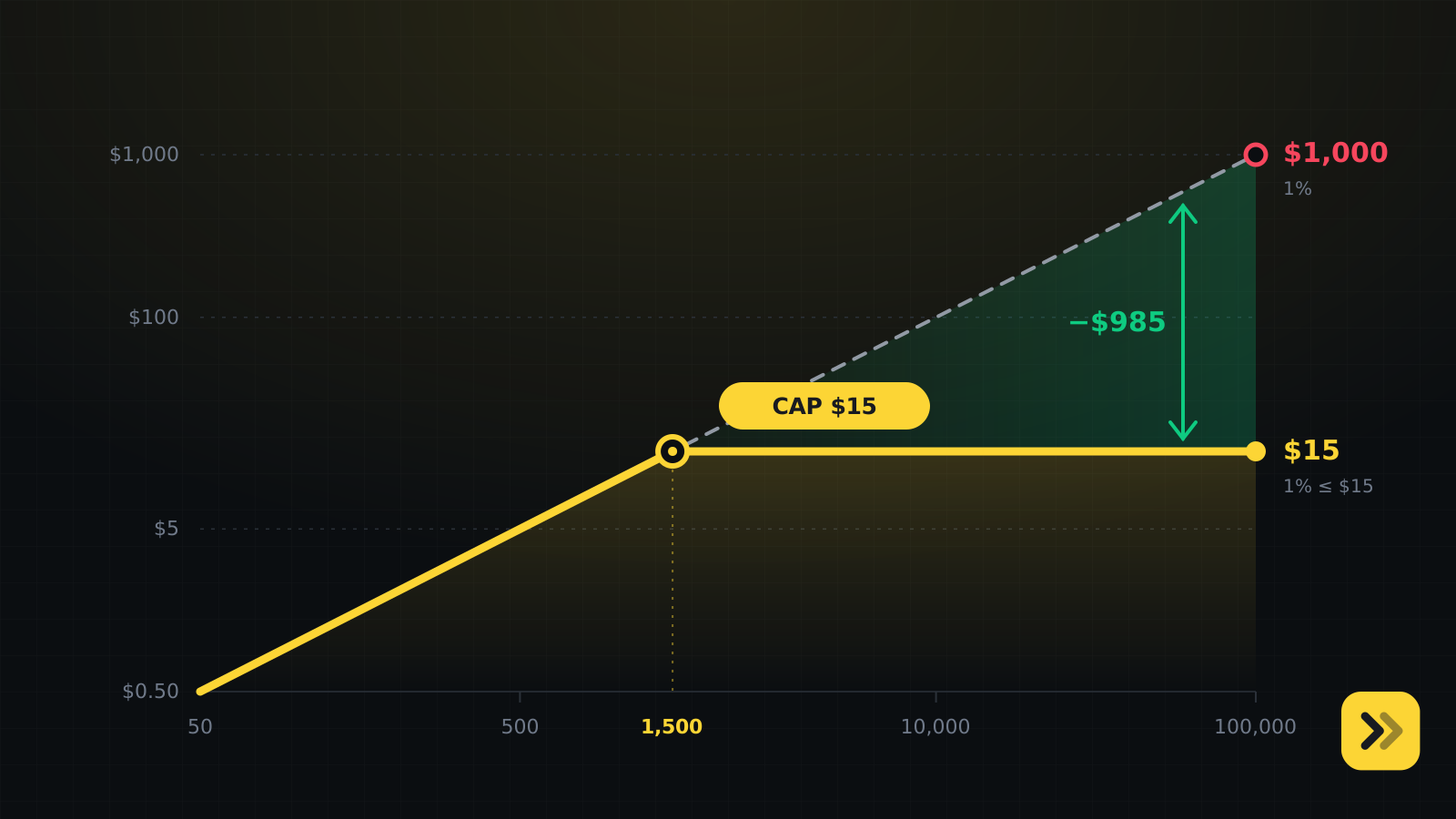
Our platform fee is now 1% of each successful payment, and never more than 15 USD on any single transaction.
It used to be a flat 0.1% with no cap. That is a real increase for small orders, and we would rather say so in the first paragraph than bury it under a paragraph about how excited we are.
The cap is the part worth reading about.
The old number was not researched, it was assumed
0.1% was picked early, before we had looked at what this market actually charges. When we finally did the work, the result was uncomfortable: published rates for crypto payment gateways run from about 0.5% at the low end to 3% at the high end, and the discounted rates that large merchants negotiate privately still sit around 0.4%.
We were charging four times less than the negotiated floor of the entire market.
That sounds like a competitive advantage until you look at how merchants actually decide. The anchor in a merchant's head is card processing at roughly 2.9% plus a fixed 30 cents. On a 50 USD order, that is about 1.75 USD. A 1% crypto fee is 50 cents. A 0.1% fee is 5 cents.
The step from 1.75 down to 0.50 is a real decision. The step from 0.50 down to 0.05 is not — both are already "basically free" against the anchor. We were giving away most of our revenue in exchange for a difference nobody was going to feel.
There is a second problem with pricing far below a market floor, and it is worse than the lost revenue. When every published rate sits at 0.5% or above and one provider says 0.1%, merchants do not conclude "cheap". They start looking for the hidden fee. For a service whose whole pitch is that the money never touches us, being the one number that looks too good to be true works directly against the thing we are trying to prove.
What a cap actually does
Most gateways charge a percentage with no ceiling. That is fine at 50 USD and absurd at 50,000 USD, because processing a large payment costs the provider exactly what processing a small one costs: derive an address, watch it, send a webhook. The work does not scale with the amount. The fee does.
So we capped it.
| Order value | Our fee | 1% with no cap |
|---|---|---|
| 50 USD | 0.50 | 0.50 |
| 500 USD | 5.00 | 5.00 |
| 1,500 USD | 15.00 | 15.00 |
| 10,000 USD | 15.00 | 100.00 |
| 100,000 USD | 15.00 | 1,000.00 |
The cap starts to bite at 1,500 USD. Below that you are paying an ordinary 1%. Above it, you are paying less than anyone publishing a flat percentage, and the gap grows with every order.
If you sell high-ticket items — equipment, wholesale lots, annual licences, B2B invoices — this is the number that matters to you, and it is not a number most of this market offers.
Plans
If you process regularly, a plan is cheaper than paying per transaction. Each plan gives you a monthly allowance; anything beyond it is billed at the standard rate.
| Plan | Per month | Volume included | Orders included | Effective rate at the limit |
|---|---|---|---|---|
| Pay as you go | — | — | — | 1.0% · capped at 15 USD |
| Starter | 19 USD | 4,000 USD | 400 | 0.475% |
| Growth | 49 USD | 12,000 USD | 1,200 | 0.408% |
| Pro | 119 USD | 36,000 USD | 3,600 | 0.331% |
| Business | 299 USD | 110,000 USD | 11,000 | 0.272% |
| Scale | 699 USD | 320,000 USD | 32,000 | 0.218% |
Two things about this table are deliberate.
The effective rate falls at every step. Moving up a plan is supposed to be an economic decision, not something you are forced into when you run out of room. A ladder where the rate stays flat is not a pricing structure, it is a capacity meter.
You never hit a wall. Going over your allowance does not stop your payments or trigger a penalty. The excess is simply billed at the pay-as-you-go rate, which means the point where the next plan becomes cheaper always lands comfortably inside that plan's range. Starter becomes Growth at around 7,000 USD of monthly volume; Growth covers up to 12,000. You will generally notice the better price before you notice the limit.
Allowances reset every 30 days.
What did not change
Network fees are still paid by your customer, and we still take none of them. Payments go from your customer's wallet directly to the address you configured. There is no intermediate address, so there is no sweep, so there is no second network fee. Providers who route payments through their own addresses first pay that fee on every transaction — on some networks that is several dollars per payment, which quietly eats a meaningful share of a small order.
We still hold no keys. The only money that ever reaches us is the prepaid balance you top up to pay these fees. That is our revenue, paid in advance by you, and it is completely separate from the payment flow between your customer and you.
A fee is locked in when an invoice is created. Whatever the rate is at that moment is the rate that invoice will be charged, for its whole life. Changing our pricing never reprices work already in flight.
When
The new rate is live now. Pricing is published in full on the pricing page, and that page is the source of truth — if you ever find a number in our documentation that disagrees with it, the pricing page wins and the documentation is a bug.